
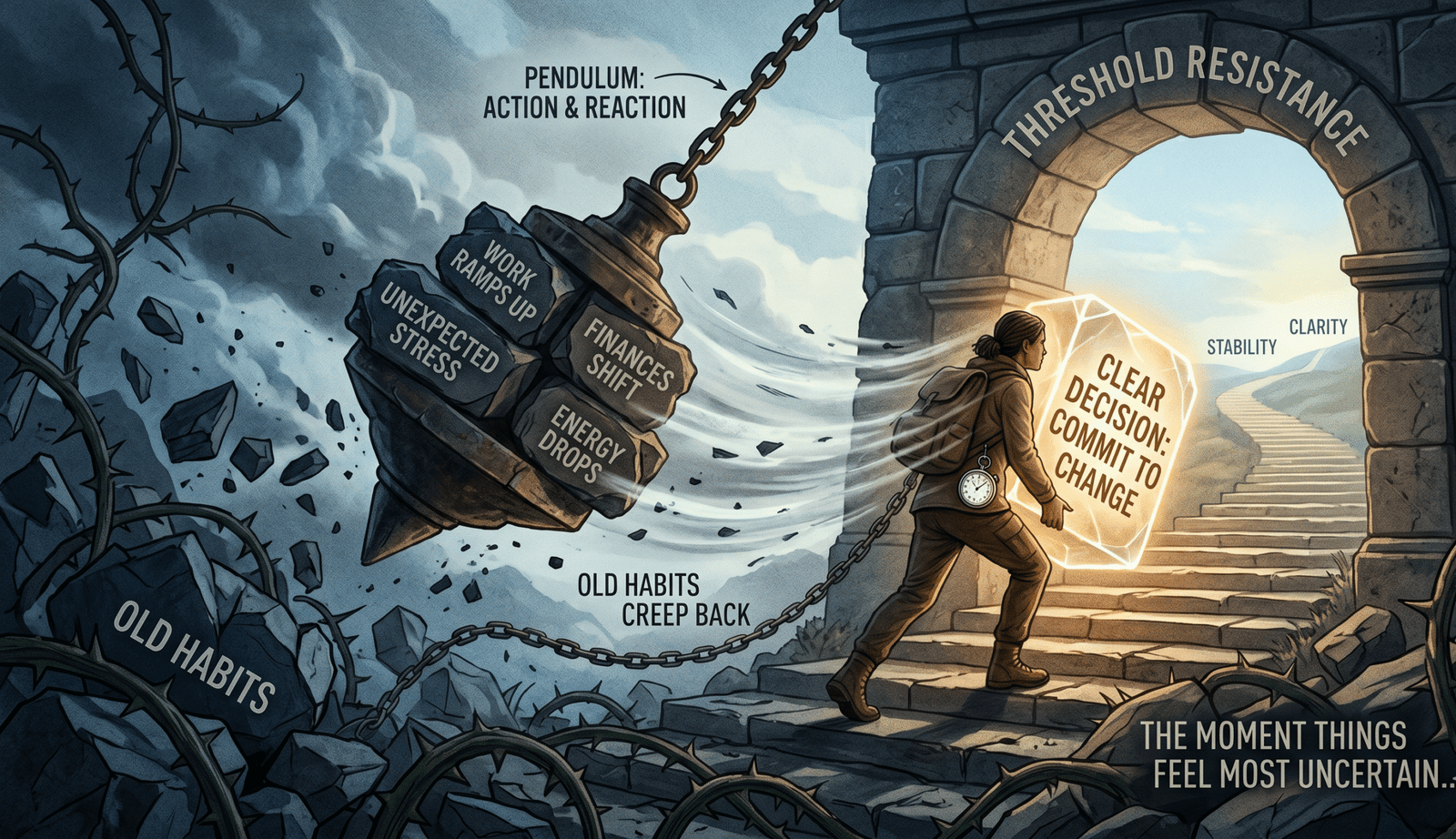
There’s a pattern I’ve seen across many clients — and experienced personally.
Someone makes a clear decision:
- “I’m going to change this.”
- “I’m committing to this goal.”
- “Things are going to be different now.”
And then, almost immediately… something happens.
Work ramps up.
Unexpected stress appears.
Finances shift.
Energy drops.
Old habits creep back in.
It can feel like:
“Why now? I just decided to change.”
Some people interpret this as bad timing.
Others see it as a sign they’re not ready.
But there’s a more grounded explanation.
What’s Actually Happening (Clinically Speaking)
In psychology, there’s a concept called Extinction burst.
When you begin to change a pattern:
- The old pattern often intensifies before it fades
Your system is used to operating a certain way.
When you interrupt that pattern, it doesn’t quietly disappear — it pushes back.
Not because something is wrong.
But because your system is trying to maintain what’s familiar.
From a science lense (sorry to get sciency on you), this is also Newton’s Third Law: Action & Reaction.
The law states that for every action (force) in nature there is an equal and opposite reaction. In other words, if we decide to do something then the opposing force that prevents us from doing the thing becomes active.
I call this force a “Pendulum” and my clients will hear me talk about it often, which I think is fitting for a hypnotherapist 😉
Why This Derails People
Where people get stuck isn’t the obstacle itself.
It’s the interpretation:
- “This must mean I’m not ready”
- “Now isn’t the right time”
- “I need to get things sorted first”
So they pause.
They wait.
They try to prepare more.
And in doing so, they often return to the very patterns they were trying to change.
The Myth of Being “100% Ready”
A common thread I see:
People believe they need to feel fully ready before they move forward.
But in reality:
- Clarity often comes after action
- Confidence builds through movement
- Stability develops while navigating uncertainty
The people who create meaningful change aren’t the ones who wait for the perfect moment.
They’re the ones who:
- Have a direction
- Seek guidance where needed
- And allow themselves to figure it out as they go
Threshold Resistance
You could think of this phase as:
Threshold resistance — the point where old patterns and new direction meet.
It’s not a sign to stop.
It’s the point where:
- Decisions are tested
- Patterns surface
- And a new direction either stabilises… or collapses
A Simple Reflection Tool
Take a moment to reflect:
Think of a time you achieved something meaningful.
- What obstacles appeared once you committed to it?
- Did things get harder before they got easier?
Now compare:
Think of a time you didn’t follow through.
- What showed up then?
- What did you tell yourself about why you stopped?
What’s the difference between the two?
In most cases, it isn’t the absence of obstacles.
It’s the response to them.
A More Useful Way to See It
Instead of:
“This is a sign to stop”
Try:
“This is the phase where the old pattern is losing its grip”
Because often, the moment things feel most uncertain
is the moment something is actually shifting.
Closing Thought
If nothing challenged your decision,
there would be nothing to change.
If you’d like support working through this process in a structured way,
you’re welcome to reach out